feature request involves adding a new metadata field, endpoint, or API capability to the Hugging Face Hub ecosystem.
Feature Request: Claim-to-Evidence Coverage and Contradiction API
Pre-flight checklist
- [x] This is an API feature request, not a consumer app or Hugging Chat UI request.
- [ ] Check current documentation and forum topics for closely equivalent functionality before posting.
- [x] The developer workflow or API use case is described below.
Feature type
New response field or metadata; New endpoint or API capability
Affected API area
Search API; Agent API (Hugging Face Hub / Client Ecosystem)
Summary
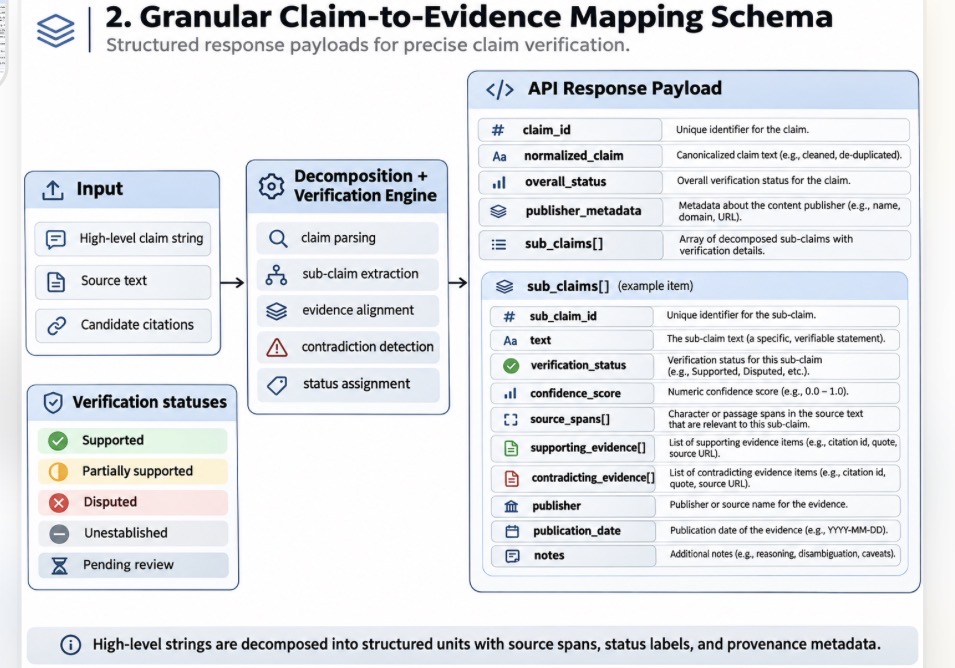
Introduce a capability to show which parts of a compound claim are supported, disputed, or not established by a cited record on the Hub.
Problem
One source may validate a specific metadata field or date but not an alleged motive, impact, or causal relationship. A citation alongside an entire sentence can misrepresent its evidential scope, creating downstream tracking challenges in automated audit-ready compliance data.
Proposed API behavior
Return fine-grained claim components and per-component evidence links. This includes:
- Source spans (where permitted)
- Support type classifications (e.g., supported, disputed, unestablished)
- Cross-references to contrary records or missing elements
- Reviewer/curator qualification metrics
Uncertain interpretations should be kept explicit in the schema rather than flattening them into an unsupported numerical confidence score.
Example usage
For a claim that a specific repository policy changed in March and directly caused a later optimization improvement, the API should confirm the dated policy change component via metadata while marking the claimed causal impact component as not established.
Workarounds tried / considered
Developers currently must manually split claims and programmatically parse or compare excerpts using foundational LLMs. These methods require extra latency-heavy verification loops and frequently conflate model inference with actual source-supported facts.
Impact
Research, legal-policy, educational, and compliance-driven applications (such as EU AI Act auditability workflows) benefit immediately from high-precision citations, robust provenance tracking, and fewer overextended conclusions across downstream agents.
Additional context
This layout is distinct from generic source credibility scoring or foundational model fact-checking. Instead, it systematically verifies whether exact underlying evidence supports each structurally asserted component.
Proposal attribution: Grace R. Nettey — Manifold Grace. Human-led conceptual research, with AI assistance in structuring and drafting. This request invites engineering consideration and community discussion; it does not demand immediate implementation.
Related foundations & references:
- Interoperable Institutional Evidence Verification API with Provenance Tracking: Interoperable Institutional Evidence Verification API with Provenance Tracking - Feature Requests - Perplexity API Platform Forum



Pre-flight checklist
- This is an API feature request, not a consumer app or Comet UI request.
- Check current documentation and forum topics for closely equivalent functionality before posting.
- The developer workflow or API use case is described below.
Feature type
New response field or metadata; New endpoint or API capability
Affected API area
Search API; Agent API
Summary
Show which parts of a compound claim are supported, disputed or not established by a cited record.
Problem
One source may validate a date but not an alleged motive, impact or causal relationship. A citation alongside an entire sentence can misrepresent its evidential scope.
Proposed API behavior
Return claim components and per-component evidence links, including source spans where permitted, support type, contrary records, missing elements and reviewer qualification. Keep uncertain interpretations explicit rather than converting them to unsupported numerical confidence.
Example usage
For a claim that a policy changed in March and directly caused a later improvement, the API can confirm the dated policy change while marking the claimed causal impact as not established.
Workarounds tried / considered
Developers can manually split claims and compare excerpts, or ask models to do so; these methods require verification and may conflate inference with source-supported fact.
Impact
Research, legal-policy, education and compliance applications benefit from more precise citations and fewer overextended conclusions.
Additional context
This is distinct from generic source credibility or model fact-checking: it asks whether exact evidence supports each asserted component.
Proposal attribution: Grace R. Nettey — Manifold Grace. Human-led conceptual research, with AI assistance in structuring and drafting. The request invites consideration; it does not demand implementation.
Related foundation: